


By the Ridgeside K9 Training Team — Updated October 2026
Your dog walks beautifully for you. Great. Now hand the leash to your spouse. What happens?
Can your veterinarian touch your dog’s ears without you holding their head? Can a technician take the leash and walk your dog into another room? Can a groomer lift a paw? Can your trainer clip a leash to the collar without the dog ducking away? Can a trusted family member guide the dog into a crate? Can somebody else put on the harness you use every day?
These situations are easy to ignore, because most owners do almost everything themselves. You attach the leash. You feed the dog. You open the crate. You wipe the paws. You clean the ears. You brush the coat. You get the dog into the car. You know exactly how your dog likes to be approached and where they don’t like being touched.
Then one day somebody else has to do it. That’s when an overlooked hole in training becomes obvious.
Dog handling training isn’t about teaching your dog to adore every stranger or accept unlimited touching from anyone who reaches toward them. It’s about teaching appropriate cooperation with necessary handling. A dog should be able to understand that another competent person may sometimes need to hold the leash, touch their body, examine them, guide them, groom them, or move them from one place to another.
That skill matters at the veterinarian. It matters at the groomer. It matters during boarding. It matters during professional training. It matters when you travel. It matters if a family member needs to care for the dog. And it matters any time the person who normally handles the dog can’t be the only person capable of doing it.
A dog who can only function safely in one person’s hands may have excellent obedience in some areas. They still have an important life skill left to learn.
Quick Answer: Dog handling training teaches a dog to remain comfortable and manageable when another appropriate person needs to leash, guide, examine, groom, restrain briefly, or touch them. Start with easy handling from the primary owner, including the collar, shoulders, paws, ears, mouth, tail, and body. Then gradually introduce equipment, movement, different environments, and trusted people. The goal isn’t forced tolerance of unlimited touching. The goal is a dog that understands necessary handling and can remain safe and cooperative with veterinarians, technicians, groomers, trainers, family members, and other trusted caregivers.
Table of Contents
- Handling is a life skill, not a personality test
- There are several kinds of handling
- Why dogs behave differently when somebody else takes the leash
- Start with collar and leash handling
- Teach your dog to move with another person
- Body handling needs to be trained too
- Grooming exposes handling gaps quickly
- Veterinary handling should not begin at the veterinary clinic
- Cooperative care can make necessary handling clearer
- Family members need handling skills too
- Build a handling ladder instead of testing everything at once
- Watch what your dog says before they escalate
- Sudden handling problems may not be training problems
- Puppies have an enormous advantage
- Adult dogs can still learn
- Dogs with aggression or bite histories need a different plan
- The dog handling skills test
- How Ridgeside K9 builds transferable handling and obedience
Handling Is a Life Skill, Not a Personality Test
A dog doesn’t need to be socially obsessed with strangers to be handled safely. That distinction matters.
Some dogs naturally love nearly everybody. Others are neutral. Some are reserved. A dog can prefer their owner and still learn that a veterinarian touching an ear isn’t a reason to panic. A dog can be socially selective and still allow a groomer to handle a paw. A dog doesn’t need to seek affection from a trainer in order to follow that trainer on leash.
We shouldn’t confuse handling tolerance with friendliness.
“He doesn’t like strangers” is not the end of the conversation
That statement may be completely accurate. Now ask a second question: what necessary interaction can the dog safely tolerate?
There’s a real difference between asking a reserved dog to enthusiastically socialize with every person they meet and teaching the dog to allow a trained veterinary professional to perform an examination. The first may be unnecessary. The second could become medically necessary. That’s why dog handling training is foundational training.
The goal is not helpless tolerance
Good dog handling training shouldn’t teach the dog that people can do anything they want while the dog shuts down and endures it. The better goal is predictability. The dog learns: a person reaches for my collar, I know this. A hand moves toward my paw, I’ve practiced this. Someone looks in my ear, I know what happens next. A different person takes my leash; I still understand how to move with them.
Familiarity can remove a great deal of uncertainty.
There Are Several Kinds of Handling
Owners often hear “handling” and think only about petting. That’s a tiny piece of it. Dog handling training actually breaks down into several distinct skills.
Equipment handling
This includes someone touching or holding the collar, harness, leash, crate, long line, muzzle (when appropriately trained), grooming equipment, or veterinary equipment. A dog may be perfectly comfortable being petted while becoming defensive the moment someone reaches toward the collar. Those are genuinely different experiences.
Movement handling
Can someone guide the dog through a doorway? Onto a scale? Into a crate? Toward a grooming table? Into a veterinary exam room? Away from another dog? Into a vehicle? The dog needs to understand how to move with another handler rather than planting, spinning, grabbing the leash, or trying to return immediately to the owner.
Body handling
This includes touching and examining the paws, legs, ears, eyes, mouth, teeth, tail, abdomen, back, neck, coat, and skin. Dogs Trust recommends introducing this kind of handling gradually, in short sessions, starting with body areas the dog already accepts and moving carefully into more sensitive ones, then eventually introducing new people and different environments once the foundation feels solid.
Procedural handling
This is where training turns extremely practical. Can the dog tolerate brushing? Nail handling? Ear cleaning? A stethoscope? Having lips lifted? An injection setup? Eye or ear medication? A bandage? A thermometer? Standing still for an examination?
Some of these things will always feel strange to a dog. Training doesn’t have to make them enjoyable. It can make them understandable.
Why Dogs Behave Differently When Somebody Else Takes the Leash
Owners see this all the time. The dog walks beautifully for the trainer but pulls the owner. Or the opposite. The owner can touch the dog’s feet, but the groomer can’t. The trainer can move the dog away from another dog, but a family member gets ignored.
That doesn’t mean the dog is plotting anything. Dogs learn patterns attached to people. Your movement matters. Your timing matters. Your posture matters. Your reinforcement history matters. Your leash habits matter. What you allow matters. Another person creates a completely different picture.
Your dog may know your choreography
Think about everything you do without realizing it. You bend slightly before reaching for the collar. You say the dog’s name before touching an ear. You always approach from the same side. You loosen the leash before opening the crate. You scratch the dog’s chest before checking a paw.
Your dog may have learned that entire sequence. Then a veterinary technician walks in and reaches differently, and the dog suddenly looks a lot less comfortable. That’s exactly why training needs generalization. The lesson eventually has to survive changes in people, location, body position, and context.
Handler dependence can hide weak understanding
A dog may appear extremely well trained because the primary owner manages every detail perfectly. Then someone else takes over, and the whole system falls apart.
That’s actually useful information. The dog may understand the owner’s routine more than the behavior itself. Handling practice with trusted people can reveal that gap before the situation actually matters.
Start With Collar and Leash Handling
Before worrying about nail trims or veterinary exams, start with something your dog experiences constantly: the collar.
Can you calmly take hold of it? Can you clip on a leash without the dog dodging? Can another family member do the same? Can the dog stay relaxed while someone briefly maintains control of the collar? This is an extremely practical skill.
Reaching shouldn’t automatically create avoidance
Some dogs start dodging the second a hand moves toward the neck. Owners respond by chasing. The dog dodges again. Now collar handling becomes a game or a conflict.
Slow the process down. Reach toward the collar. Reward calmness. Touch it. Release. Hold briefly. Release. Clip the leash. Move together. The dog should learn that hands near the collar predict clear, ordinary interaction, nothing more.
Practice from different positions
Owners often clip the leash on while standing directly in front of the dog. Try other realistic pictures once the dog’s comfortable: beside the dog, while seated, near the front door, beside the car, with the dog on place. Then have a trusted person repeat the easier versions.
You’re teaching a concept here, not one memorized scene.
Teach Your Dog to Move With Another Person
Handover is more than putting a leash in someone else’s hand. The dog needs to actually move with that person. That can be surprisingly difficult for dogs who are strongly attached to one handler.
Owner hands leash to trainer. Owner walks away. Dog hits the end of the leash trying to follow. Or freezes. Or spins. Or ignores everything the new handler says. That’s exactly why the skill deserves real practice.
Begin with both people present
Don’t immediately disappear. Have the second handler take the leash while you remain nearby. They walk a few steps. Dog follows. Reward. Return. Repeat. Gradually increase the distance between you and the dog.
The lesson isn’t abandonment. The lesson is that another trusted person can temporarily become relevant.
Keep the communication consistent
If your dog knows specific cues, tell the other person what they are. If the dog understands a particular release cue, use the same one. If there are equipment rules, explain them. The second handler shouldn’t have to invent a training system while holding the leash.
This matters especially in families. A dog can’t be expected to perform one clean behavior when every person uses different words and different expectations.
Body Handling Needs to Be Trained Too
A dog who enjoys petting may still dislike examination. Petting usually happens in places dogs already enjoy being touched: shoulders, chest, back, maybe the neck. Veterinary and grooming handling is different. Somebody may need the foot. The ear. The mouth. The tail. The abdomen. Those areas deserve their own practice.
Start where the dog is already comfortable
Don’t begin with your dog’s worst body part. If the dog loves shoulder contact, start there. Touch. Release. Reward. Move a little farther down the leg. Touch. Release. Reward. Over several sessions, you may eventually reach the paw.
Paws deserve special attention
Many owners discover paw sensitivity right when nails finally need trimming. By then, every interaction with the foot has a purpose. Hold. Trim. File. Clean. Examine. That’s a difficult place to begin.
Practice touching and briefly holding paws when you don’t need anything. Run your hand down the leg. Touch the paw. Release. Later, lift it naturally. Release. Then introduce the equipment separately. Now the nail clipper isn’t arriving at the same moment as every other new experience.
Mouth handling is a separate skill
Can you lift the lip? Look briefly at the teeth? Touch around the muzzle? That can help prepare a dog for routine veterinary and dental examination.
Grooming Exposes Handling Gaps Quickly
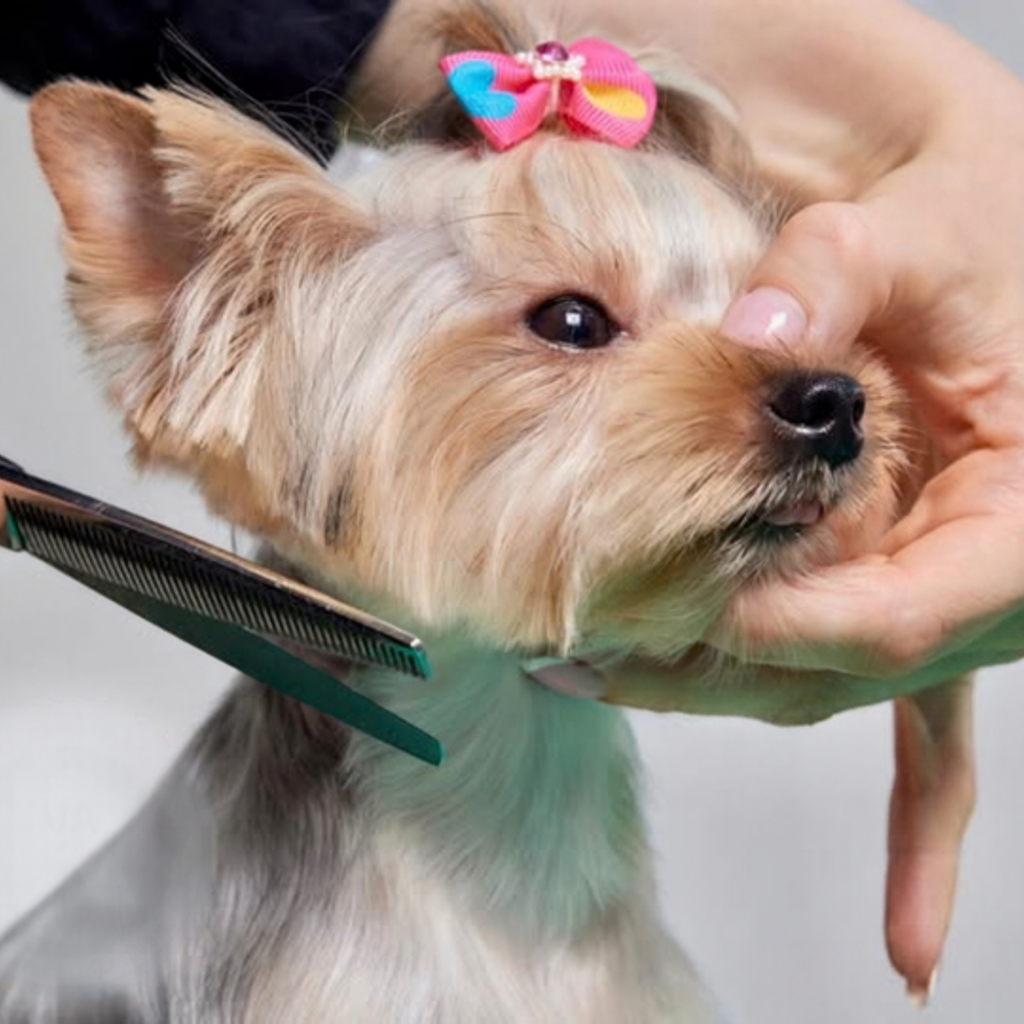
Grooming combines a lot of things dogs may find difficult all at once: standing still, being touched repeatedly, equipment near the body, noise, paw handling, ear handling, brushing, water, drying, a different person, an unfamiliar environment.
Dogs who look completely comfortable at home can struggle once those variables show up together.
Grooming starts before the appointment
A dog who’ll eventually need professional grooming shouldn’t meet every grooming sensation for the first time on the grooming table. Introduce brushing at home. Practice standing. Handle the legs. Touch the feet. Lift an ear. Use a towel. Let the dog hear grooming equipment from an appropriate distance before expecting them to stay beside it.
Teach the dog that stillness is an actual behavior
Many dogs are never taught this. They’re taught sit, down, place, come, heel. Then suddenly a groomer expects them to stand still while a leg gets handled, and the dog keeps sitting, turning, backing away, leaning, mouthing the hand.
Those behaviors may not be defiance. The dog may simply have no idea that standing quietly while being handled is part of the assignment. Practice it. Four paws planted. Brief touch. Reward. Release. Build from there.
Veterinary Handling Should Not Begin at the Veterinary Clinic
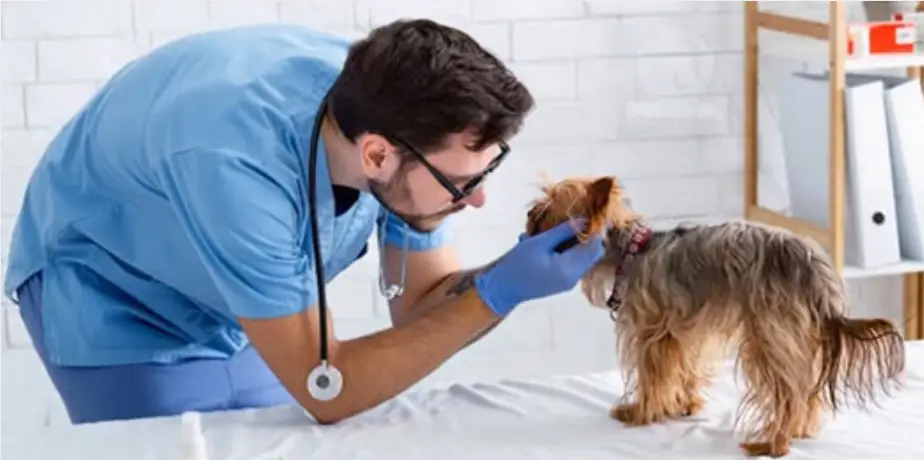
A veterinary appointment combines novelty with restraint and sometimes discomfort. That’s a lot to ask from an unprepared dog.
AAHA recommends proactive home preparation and low-stress veterinary handling, touching common examination areas ahead of time and using calm, patient handling during visits. AAHA also warns that unnecessarily forceful restraint can increase injury risk and worsen medical and emotional outcomes.
Training can’t make every medical procedure pleasant. It can reduce the number of completely new experiences arriving all at once.
Teach the exam before you need the exam
Practice standing on a mat. Being touched along the ribs. Having an ear lifted. Having the mouth examined briefly. Someone touching the paw. Standing still while an object touches the chest. Being guided by the collar. Having another person hold the leash.
Keep the sessions short. Nothing bad needs to happen. The dog’s simply learning the pattern.
The veterinary technician matters too
Owners often focus only on the veterinarian. In reality, a veterinary technician or assistant may be the person who takes the leash, gets the dog’s weight, moves the dog, positions them, collects history, assists with procedures, or handles the dog away from the owner entirely.
A dog who’s comfortable only when the owner maintains physical contact can make even routine veterinary care a lot harder. That’s exactly why another person should participate in the dog handling training plan.
Cooperative Care Can Make Necessary Handling Clearer
Cooperative care adds another layer to this conversation. Instead of simply holding the dog still and completing a procedure, cooperative-care training teaches behaviors that let the dog actively participate in parts of their own care.
AAHA describes cooperative care as an approach in which animals voluntarily participate in treatment or husbandry using trained behaviors such as targeting and stationing, and its 2025 discussion of cooperative care notes these techniques can reduce fear and stress around procedures.
A chin rest can become useful communication
For example, a dog can be trained to rest their chin on a hand or surface while the handler briefly examines part of the body. That creates a very clear position. Dog places chin. Handler touches ear. Dog remains in position. Reward.
The behavior gives the dog something concrete to do, rather than just asking them to “deal with it.”
Cooperative care doesn’t mean every procedure can be optional
Medical reality still exists. Sometimes treatment is necessary. Sometimes restraint is necessary. Sometimes sedation is the safest and most humane choice. Training isn’t a promise that every dog will voluntarily accept every procedure.
The real benefit is giving the dog a larger history of predictable, understandable handling before the difficult moments actually happen.
Family Members Need Handling Skills Too
A common household problem looks like this: one person trained the dog. One person walks the dog. One person uses the crate. One person can clean the ears. One person can control the dog when they get excited. Everybody else lives with the dog but doesn’t really handle them.
That creates dependence.
Have other adults practice routine skills
A spouse or other responsible family member can occasionally clip on the leash, take the dog outside, walk a short training pattern, send the dog to place, release them from the crate, handle the collar, check a paw, feed the dog, or guide them into the vehicle.
Nothing dramatic needs to happen. The dog simply learns that communication doesn’t disappear when the usual person steps away.
The dog doesn’t need five different systems
This only works if the humans communicate too. Use the same cues. Agree on the rules. Agree on the release word. Know how the equipment fits. Understand the dog’s handling concerns.
If one person expects the dog to wait at the door while another lets the dog explode through it, the dog’s receiving two different lessons at once. We emphasize owner education for exactly this reason. Ridgeside K9’s board-and-train programs include several hours of turnover instruction so owners learn the commands, communication system, reinforcement, and handling used with the dog, rather than simply receiving a trained dog and hoping everything transfers on its own.
Build a Handling Ladder Instead of Testing Everything at Once
Dog handling training should progress. Don’t take a dog who barely tolerates paw contact and immediately schedule a stranger to hold all four feet while clippers run beside them. Build it in layers.
Level 1: Familiar person, familiar body area
Primary owner touches an area the dog already accepts. Shoulder. Chest. Back. Brief contact. Easy win.
Level 2: Familiar person, less familiar body area
Move gradually toward legs, paws, ears, tail, mouth. Keep the interaction brief enough that the dog can stay successful.
Level 3: Add equipment
Brush. Towel. Harness. Stethoscope-like object. Nail tool without immediately using it. Grooming dryer sound at an appropriate distance. The equipment itself becomes familiar before the procedure gets difficult.
Level 4: Change the person
Trusted family member. Trainer. Known friend. Professional groomer or veterinary team member in an appropriate setting. Don’t add the hardest person and the hardest procedure on the same day.
Level 5: Change the environment
Different room. Driveway. Training facility. Grooming environment. Veterinary lobby, or a planned low-pressure visit if the clinic offers that option. AAHA described one veterinary cooperative-care case where repeated low-pressure visits helped a dog get comfortable entering the clinic, using the scale, getting onto the examination table, and interacting with staff before a later medical visit.
That progression makes a lot more sense than waiting until the dog is sick and discovering the gaps then.
Watch What Your Dog Says Before They Escalate
Handling problems rarely begin with a bite. There are usually smaller changes first. The dog turns the head away. Pulls the paw back. Closes the mouth. Becomes very still. Moves away. Drops the body. Stops taking food. Repeatedly licks the lips. Avoids the approaching hand. Whips the head toward the hand. Growls. Snaps.
Those details matter.
Don’t punish away useful information
If a dog growls during handling, take the warning seriously. A growl tells you the dog’s uncomfortable. Punishing the sound without addressing the reason can leave you with less warning next time.
Create distance. Evaluate what happened. Consider whether the dog was frightened, confused, restrained too strongly, pushed too quickly, or possibly in pain.
Don’t confuse stillness with relaxation
A dog who freezes completely isn’t necessarily cooperating. Look at the whole body. Is it loose? Can the dog take food normally? Can they move away and re-engage? Are they breathing normally? Are they choosing to stay?
Dog handling training should produce increasing confidence, not just better suppression of movement.
Sudden Handling Problems May Not Be Training Problems
If your dog has always allowed a paw to be handled and suddenly growls when you touch it, don’t assume the dog forgot their training.
Pain changes behavior. An injured paw. Ear infection. Dental pain. Skin irritation. Orthopedic discomfort. A wound hidden under the coat. Any of these can change how a dog responds to touch. Dogs Trust specifically advises owners to consider pain and veterinary evaluation when a dog suddenly becomes fearful or aggressive about handling.
Training should never become an excuse to ignore a possible medical problem.
Know the difference between “won’t” and “can’t comfortably”
If the dog moves normally until you lift one particular leg, that’s information. If brushing one side suddenly creates avoidance, that’s information. If the previously social dog becomes defensive when touched near the ear, that’s information too.
Listen before deciding the solution is firmer handling.
Puppies Have an Enormous Advantage
Puppyhood gives owners a chance to make handling ordinary before the dog develops strong opinions about it.
Touch paws. Look in ears. Lift lips. Brush gently. Handle the collar. Practice towel drying. Let another trusted person hold the leash. Teach calm standing. Introduce appropriate grooming equipment gradually. Then repeat these things throughout development.
Socialization includes handling
Puppy socialization often gets reduced to meeting people and dogs. That misses a major category of life experience. A puppy will eventually be lifted, restrained, examined, brushed, dried, leashed, groomed, possibly medicated, possibly bandaged, and handled by unfamiliar professionals.
Preparing for those experiences is social development too.
Adult Dogs Can Still Learn
Missing puppy handling work doesn’t mean the opportunity is gone. Adult dogs can learn. The process may just need to be more deliberate.
Start with what the dog already accepts. Don’t rush because you feel behind. A dog who’s spent six years avoiding paw handling may not change their opinion in one weekend.
Build trust through predictability
Use the same setup. Same mat. Same short session. Same marker. Same sequence. Then gradually vary one piece at a time. Predictability makes learning easier.
Dogs With Aggression or Bite Histories Need a Different Plan
This article is not permission to hand a human-aggressive dog to five different people and call it socialization. Safety comes first.
A dog who’s bitten during handling, threatened people near the collar, guarded their body, or shown serious defensive behavior should have an individualized plan. Don’t create unnecessary tests. Don’t ask friends to “help get the dog used to people.” Don’t rely on hope because the dog was friendly yesterday.
Management is part of training
Depending on the dog, professional planning may include controlled handler introductions, obedience and impulse control work, careful desensitization, conditioned dog handling training exercises, appropriate safety equipment, veterinary involvement, behavioral support, and muzzle conditioning when appropriate.
Our aggression and reactivity guidance emphasizes maintaining positive control, managing the environment, and never assuming that training alone eliminates risk in dogs with serious aggression histories.
That distinction matters. For some dogs, success doesn’t mean any person can handle them. Success may mean a small number of trained people can handle them safely under a carefully managed system.
The Dog Handling Skills Test
Use this as an honest assessment, not an exam you need to complete in one afternoon. Check a box where the dog is genuinely comfortable, and leave it blank where you’re not sure; that blank is your worklist.
| Handling Skill | Primary Owner | Trusted Family Member | Professional Handler | Training Needed? |
|---|---|---|---|---|
| Clip leash to collar | ☐ | ☐ | ☐ | ☐ |
| Briefly hold collar | ☐ | ☐ | ☐ | ☐ |
| Walk dog away from owner | ☐ | ☐ | ☐ | ☐ |
| Guide through doorway | ☐ | ☐ | ☐ | ☐ |
| Handle front paw | ☐ | ☐ | ☐ | ☐ |
| Handle rear paw | ☐ | ☐ | ☐ | ☐ |
| Lift and inspect ear | ☐ | ☐ | ☐ | ☐ |
| Briefly lift lip | ☐ | ☐ | ☐ | ☐ |
| Brush coat | ☐ | ☐ | ☐ | ☐ |
| Towel paws and body | ☐ | ☐ | ☐ | ☐ |
| Stand calmly for examination | ☐ | ☐ | ☐ | ☐ |
| Enter crate for another person | ☐ | ☐ | ☐ | ☐ |
| Follow another handler on leash | ☐ | ☐ | ☐ | ☐ |
| Settle after owner leaves | ☐ | ☐ | ☐ | ☐ |
Don’t treat every “no” as a failure. Treat it as information. Maybe your spouse has never handled the dog’s paws because there was no reason to. Now you know that’s worth practicing. Maybe the veterinarian can examine the dog, but the dog won’t leave the room with a technician. That tells you something different.
Dog handling training gets a lot easier once you identify the exact gap, instead of just saying the dog “doesn’t like being handled.”
How Ridgeside K9 Builds Transferable Handling and Obedience
There’s an interesting built-in lesson inside board-and-train programs. The dog has to work with somebody who isn’t the owner. That immediately reveals whether the dog’s behavior belongs to the dog, or only to one relationship.
Our board-and-train programs place dogs with an assigned trainer for daily handling and training, then include a multi-hour owner turnover at the end so the communication system can transfer back to the household. That transfer goes both directions. First, the dog learns to function with the trainer. Then the owner learns how to handle the trained dog.
Obedience should transfer between competent handlers
A dog who understands heel should be able to learn to heel for another properly instructed person. A dog who understands place shouldn’t believe the command only exists when Mom says it. A dog who understands leash communication should be capable of following familiar information from another competent handler.
That doesn’t mean every stranger should take your dog’s leash. It means the dog’s education should be bigger than one person’s habits. Our emphasis on livability, control, environmental neutrality, communication, and owner education is designed to make obedience usable beyond the trainer’s hands alone.
Handling problems need to be separated from obedience problems
A dog may know every command and still dislike having a paw touched. That’s not the same training problem. A dog may allow a veterinary examination but drag every new handler on leash. Also different. A dog may walk beautifully for multiple people but guard the collar when someone reaches toward it. Again, different.
Good evaluation separates the pieces instead of lumping everything under “obedience.”
Serious handling aggression deserves a serious plan
For dogs that growl, snap, lunge, or bite when people attempt to handle them, basic obedience alone may not resolve the issue. Ridgeside K9’s behavior-modification programs address dog and human reactivity and aggression using individualized training, controlled exposure, obedience, and long-term management.
Owners dealing with significant handling aggression can learn more through our dog aggression and reactivity program. For dogs that need a broader obedience foundation and more experience working with professional handlers, our board-and-train options cover that ground too.
Dog Handling Training Means Your Dog Can Function Without You Doing Everything
Most owners don’t think about this skill until somebody else needs it. That’s the problem.
The veterinarian reaches for the dog. The groomer needs a paw. Your spouse needs to take the leash. The trainer needs to guide the dog away. A family member needs to crate them. Suddenly everyone discovers that the dog only knows how to cooperate with one person.
Dog handling training changes that. Not by making the dog available to everybody. Not by teaching them to tolerate anything a human decides to do. And not by forcing frightened dogs through procedures until they stop fighting.
It changes the picture by making necessary handling familiar. Someone touching the collar is familiar. A paw being lifted is familiar. An ear being checked is familiar. Another trusted person holding the leash is familiar. Standing still while the body is examined is familiar. The dog has seen pieces of this before, and that familiarity matters.
Start with the easiest version. Keep it short. Build carefully. Then let trusted people become part of the dog’s education. Because a truly useful training foundation should still exist even when somebody else’s hand is holding the leash.
If your dog struggles with leash transfers, body handling, obedience for other people, veterinary or grooming situations, or more serious handling-related reactivity, contact the Ridgeside K9 team to discuss the training approach that fits your dog.